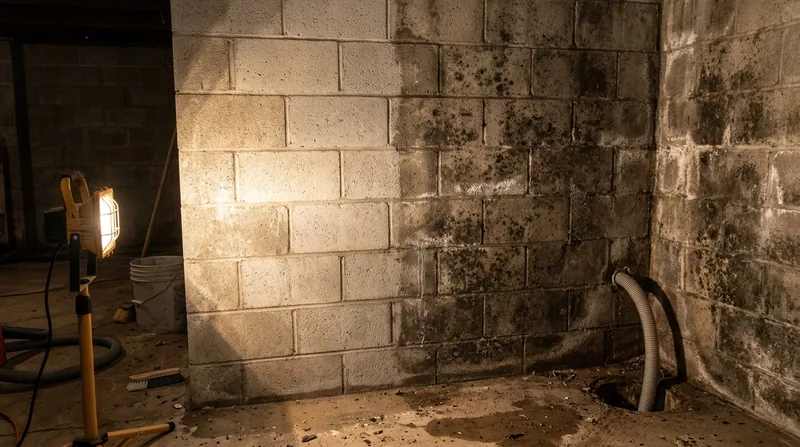




Basement Mold Remediation in Bloomington: Fix the Moisture, Not Just the Mold
When you search for Basement Mold Remediation in Bloomington, you are usually standing in a basement that smells like a wet dog and looking at a fuzzy stripe along the bottom of a limestone wall. That stripe is the symptom. The cause is water finding its way through clay-rich soil and fractured Salem limestone into a 1920s bungalow in Elm Heights or a 1990s poured-wall basement off the north side. We treat the mold, contain the dust, and then fix the moisture path so it does not come back next spring. Call (812) 778-1405 and we will walk the basement with you, nose first and moisture meter second.
Bloomington basements are not all built the same, and the mold pattern tells you which one you are in. Cut limestone and rubble stone walls in Prospect Hill wick water differently than 1950s block walls on the east side or poured walls in newer subdivisions. Our job is to read that pattern before we touch a sponge. Start with a free basement inspection and we will tell you plainly whether you have a surface mold problem or a hydrostatic pressure problem behind the wall.
Why Mold Keeps Coming Back in Bloomington Basements
Mold needs three things: moisture, organic material, and still air. Bloomington supplies all three. Spring rains and summer thunderstorms run off the wooded hills toward low lots, the water table rises, and hydrostatic pressure pushes water through cracks, mortar joints, and porous block. Old stone foundations in Elm Heights and near the university were often parged on the inside, and that parging traps moisture against the stone until efflorescence and mold bloom on the surface. Newer poured basements on the north and southwest edges are not immune: a failed sump pump or a short discharge line that dumps water back against the footing will wet the wall within a season.
- Water seeps through foundation cracks and mortar joints and feeds mold on the wall face.
- High humidity in a closed basement condenses on cool block and stone walls in summer.
- A sump pump that fails during a spring storm leaves standing water and a musty smell behind.
- Downspouts that discharge too close to the foundation push roof water into the same soil the basement wall sits in.
- Freeze-thaw cycles open old stone cracks wider each winter, giving water a bigger path each spring.
Treating the visible mold without changing one of those conditions is a short-term fix, which is why we pair remediation with a real moisture control plan.
Key info: A musty smell in a Bloomington basement after a heavy rain is a moisture signal, not a cleaning problem. In a 1940s foursquare off Prospect Hill, the smell usually traces to a rubble stone wall wicking water at the footing, not to the carpet or the stored boxes.
For official guidance on moisture and mold in buildings, the EPA mold resource page is a solid reference on moisture control and remediation principles.
How We Run a Basement Mold Remediation in Bloomington
We work in a fixed order: diagnose, contain, remove, treat, then correct the moisture source. Skipping the last step is why mold returns. A basement in Smithville-Sanders with a damp block wall and a failed footing drain gets a different plan than a poured-wall basement in a 2000s subdivision with a working sump but a humid summer. We measure moisture content in the wall and the air, not just the visible staining.
- We inspect the basement, the wall base, the floor joint, and the sump area, and we map every wet spot with a moisture meter.
- We set up containment with plastic sheeting and negative air pressure so spores do not spread to the rest of the house during work.
- We remove mold-damaged drywall, insulation, or wood that cannot be cleaned, and we bag it on site.
- We clean and treat affected masonry and framing with appropriate remediation products and HEPA vacuum the surfaces.
- We correct the moisture path, which may mean crack injection, an interior perimeter drain, a vapor barrier, or a sump and discharge fix.
- We verify dryness with a final moisture reading and leave you a written summary of what was done and what to watch.
If the moisture source is a wall that needs drainage rather than a surface treatment, we will say so before the remediation invoice gets bigger than it needs to be.
Key info: On a 1960s split-level in Ellettsville, mold had grown along the bottom of a block wall where the exterior grade sloped back toward the house. We remediated the wall, extended the downspouts, and regraded the soil. No drain tile was needed, and we told the homeowner that up front.
When the diagnosis points to a wet wall rather than a surface issue, the next step is usually an interior drain tile system that captures water at the wall base and routes it to a sump.
Remediation and Moisture Control Methods We Use
The right method depends on the material that is moldy and the reason it got wet. We match the approach to the wall type and the water source, not to a one-size package. Here is how the main options compare for Bloomington basements.
| Approach | Description | Best for |
|---|---|---|
| Surface remediation and treatment | Containment, HEPA vacuuming, cleaning and treating mold on masonry and framing, then verifying dryness. | Mold on block, stone, or framing where the moisture source is minor and correctable. |
| Crack injection plus remediation | Epoxy or polyurethane injection into foundation cracks, then treatment of the mold the seepage caused. | A defined seepage crack in a poured or block wall with mold along that line. |
| Drainage correction plus remediation | Interior perimeter drain, sump basin and pump, then remediation of the wall and floor area. | Hydrostatic pressure and water at the wall base, common in old stone and block basements. |
| Vapor barrier and dehumidification | Vapor barrier on walls or floor, sealed joints, and controlled dehumidification to hold humidity down. | Humidity-driven mold in finished or partly finished basements with no active leak. |
| Material removal and rebuild prep | Removal of mold-damaged drywall, insulation, and trim, with the wall left ready for a moisture-safe rebuild. | Finished basements where mold has spread behind the wall surface. |
Each of these is a moisture control step first and a mold step second, because the mold will not stay gone if the water path stays open.
Basement Mold Remediation Cost in Bloomington: What to Expect
Most basement mold remediation in Bloomington starts around From $1,500 for a contained, single-area job with surface treatment and a moisture diagnosis. The figure moves with square footage affected, how much porous material has to come out, whether the wall is cut limestone, rubble stone, block, or poured concrete, and whether drainage correction is part of the fix. A small stripe along a block wall in a Gosport ranch is a different job than a finished basement in a north-side subdivision where mold has spread behind drywall.
Access matters too. A low, cluttered basement near the university takes longer to contain and work in than an empty one. If a sump pump has failed and water sat for days, expect more material removal. We give you a scope and a number before work starts, and we separate remediation from any drainage or waterproofing work so you can see what each part costs. Getting two or three estimates is smart, and any contractor who will not put the moisture correction in writing is telling you something. Our full pricing overview lays out how we build an estimate.
Hiring a Basement Mold Remediation Contractor Near Bloomington
You want a contractor who diagnoses moisture before quoting mold work, carries liability and workers comp coverage, and will show you the certificate. Ask whether containment and negative air are standard on every job, and ask what happens if the moisture source turns out to be a footing drain rather than a surface condition. A firm that only cleans mold and never opens a wall or reads a moisture meter is a cleaning service, not a remediation contractor.
- Confirm the company is licensed and insured and ask for a certificate before work begins.
- Get two or three written estimates with the same scope so you compare like with like.
- Ask for local references from basements similar to yours, stone, block, or poured.
- Check whether structural or drainage work needs a permit from the local building department, since rules vary by jurisdiction.
- Ask how they verify dryness at the end, and get that in the written summary.
If a contractor cannot explain why the mold grew, keep looking. You can reach us through our contact page to set up a walkthrough and a free estimate.
Basement Mold Remediation Near Me: What Bloomington Homeowners Should Know
Searching for basement mold remediation near me in Bloomington usually means you have already smelled it or seen it, and you want someone who will not just paint over it. The local failure mode that dominates here is water at the wall base after spring rain, driven by hydrostatic pressure in clay soil over fractured limestone. That is why we treat the wall, then correct the drainage or the crack, then verify the basement is dry. If the fix is simple crack sealing, we will tell you. If the real answer is an interior drain tile system, we will show you why before you spend money on surface work that will not hold.
Local Conditions That Drive Mold in Bloomington
Bloomington sits in limestone country, and that geology shapes how water moves around a foundation. Clay-rich soil holds water against the wall, and fractured Salem limestone lets it travel through rock as well as soil, feeding seepage cracks, springs, and the occasional sinkhole. Spring rains and summer thunderstorms send runoff down the wooded hills toward low lots, and freeze-thaw cycles widen cracks in old stone each winter. The soft, muted light under the hardwood canopy hides how wet a basement wall really is until the musty smell gives it away.
Older bungalows and foursquares in Elm Heights and Prospect Hill often have full basements of cut limestone or rubble stone with original parging that has failed. Ranches and split-levels on the east and south sides have block walls and partly finished basements where mold grows along the floor joint. Newer subdivisions on the north and southwest edges have poured full basements that stay dry until a sump pump fails or a discharge line is short. Each type fails in its own way, and the remediation plan follows the failure. If you are in Ellettsville, Gosport, or Spencer, the same limestone and clay conditions apply, and our service area page shows where we work.
Basement Mold Remediation in Bloomington: Pricing Guide
| Service | Price | Details |
|---|---|---|
| Contained surface remediation | Starting at $1,500 | Includes containment, HEPA vacuuming, treatment of affected masonry or framing, and a final moisture reading. |
| Remediation with crack injection | Starting at $2,200 | Adds epoxy or polyurethane injection of the seepage crack that fed the mold, priced by crack length and wall type. |
| Remediation with drainage correction | On estimate | Needs an on-site look because interior drain tile, sump work, and vapor barrier scope vary widely by basement. |
| Material removal and rebuild prep | On estimate | Priced by square footage of mold-damaged drywall, insulation, or trim removed and bagged on site. |
| Travel | Included | in Bloomington and surrounding areas, no separate call-out or mileage fee |
| Estimate | Free | Response within 24h at (812) 778-1405, no obligation to book |
Indicative pricing, the exact cost depends on square footage, finish, and site access. Free personalized estimate within 24h at (812) 778-1405.


