



Basement Waterproofing in Bloomington: Stop the Water at the Source
When you need Basement Waterproofing in Bloomington, the first step is understanding that water here rarely comes from one place. Bloomington sits on clay-rich soil over fractured Salem limestone, and the county's quarries have cut that rock for generations, so water moves through the stone as well as the dirt above it. In Elm Heights and Prospect Hill, 1920s bungalows and foursquares sit on cut limestone and rubble stone foundations that have absorbed a century of freeze-thaw cycles. On the east and south sides, 1950s and 1960s ranches and split-levels have block walls that crack along the mortar joints. North and southwest subdivisions built in the 1990s and 2000s have poured full basements that seep at the floor joint when the water table rises. We trace the actual path the water takes, then build the system that fits the house instead of selling the same package to every address. Start with a free basement inspection and we will tell you plainly what you are dealing with.
Why Bloomington Basements Leak: Limestone, Clay, and Old Foundations
The failure mode that dominates here is hydrostatic pressure at the footing. Spring rains and summer thunderstorms run off the wooded hills toward the low lots, and the clay holds that water against the wall until it finds the weakest point: the cove joint where the floor meets the wall, a mortar joint in an old stone foundation, or a hairline crack in a poured wall. Old stone foundations in Elm Heights weep through the mortar itself, and you will see the white chalky bloom of efflorescence on the wall long before water reaches the floor. Block walls on the east side show stair-step cracks at the corners. Newer poured walls on the north edge crack at the shrinkage joints and at the tie holes. Each one points to a different repair.
- Water entering at the floor joint points to hydrostatic pressure and usually calls for an interior perimeter drain, not a patch on the wall.
- Rust streaks or a white bloom on the wall means water is moving through the masonry and the wall needs sealing or injection before anything else.
- A musty basement smell after rain usually means moisture is trapped behind a finished wall or under a floor covering.
- Water pooling in one corner after a storm often traces back to grading and downspout extensions, not the foundation itself.
- A sump pump that runs constantly in dry weather is a sign the water table is feeding the basin through the drain tile.
Diagnosing the source correctly on the first visit is what separates a repair that holds from one that gets redone next spring.
Key info: A 1930s foursquare in Prospect Hill with a rubble stone foundation will not respond to the same treatment as a 1990s poured-wall ranch off Kinser Pike. Stone foundations weep through the mortar bed and need repointing and sealing; poured walls crack at control joints and respond well to epoxy or polyurethane injection.
The Indiana Department of Homeland Security publishes the state building code that local inspectors enforce, and you can review the current adopted edition at in.gov/dhs before you plan any structural work.
How We Waterproof a Bloomington Basement: Trace, Drain, Seal, Discharge
We work from the water path outward, not from a catalog. The first hour on site is spent reading the foundation: where the water enters, how the grade slopes, where the downspouts dump, and whether the sump basin is doing its job. From there we build a sequence that matches the house, the wall material, and the budget. Most Bloomington jobs follow four steps, and we tell you up front which steps you actually need.
- We map the water path with a moisture meter and a visual walk of the interior and exterior, checking the cove joint, wall cracks, window wells, and the grade line.
- We correct the cheap problems first: grading that slopes back to the wall, downspouts that dump at the foundation, and window wells that hold water against the sill.
- We install the drainage the wall needs, either an interior drain tile system at the footing or exterior waterproofing when the wall itself is failing.
- We seal the wall surface and close the system with a sump basin, pump, check valve, and discharge line that moves water well away from the foundation.
Every job ends with a wet test and a walkthrough so you know what the system does and how to maintain it.
Key info: A split-level off South Walnut with water at the cove joint after every heavy rain got an interior perimeter drain and a new sump basin tied to a battery backup. The homeowner had already paid twice for crack patching that failed because the pressure was coming from under the floor, not through the wall.
Waterproofing Methods We Use in Bloomington Homes
The right method depends on where the water enters and what the wall is made of. We match the approach to the failure, and we will tell you when a simple repair is enough and when the pressure calls for a full system. The table below shows the main approaches we use across Bloomington and the surrounding towns.
| Approach | Description | Best for |
|---|---|---|
| Interior perimeter drain | We cut a channel at the footing, lay perforated pipe in washed stone, and route it to a sump basin. | Hydrostatic pressure at the cove joint and water rising through the floor. |
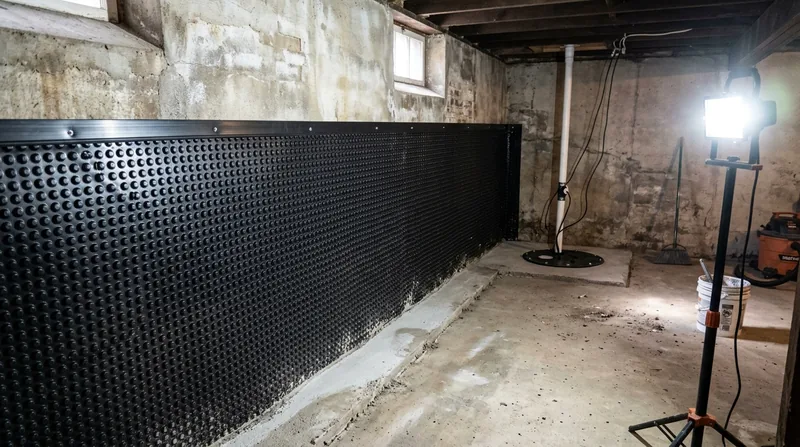
| Exterior waterproofing | We excavate to the footing, apply a waterproof membrane and dimple board, and restore the drain tile. | Failing walls, bowing block, and stone foundations that cannot be saved from inside. |
| Crack injection | We set injection ports and pump epoxy or polyurethane into the crack to fill it from the inside out. | Active seepage through a poured wall crack with no wall movement. |
| Wall sealing and vapor barrier | We parge and seal the wall, then hang a vapor barrier to keep moisture out of the room. | Damp walls, efflorescence, and finished basements that smell musty. |
| Sump and discharge | We set a sump basin with a primary pump, check valve, and a discharge line that exits well clear of the wall. | Any drained system, plus homes where the existing pump is undersized or failing. |
We will not sell you exterior excavation when an interior drain solves the problem, and we will not patch a wall that is moving.
Basement Waterproofing Cost in Bloomington: What to Expect
Most Bloomington basement waterproofing work starts around $2,500, and that figure usually covers a focused repair: crack injection, wall sealing, grading correction, and a downspout fix. A full interior drain tile system with a sump basin and pump typically runs higher because it involves cutting the perimeter, hauling stone, and tying in the discharge. Exterior excavation is the highest tier because it means digging to the footing and restoring the grade. The number moves with the wall material, the length of the perimeter, whether the basement is finished, and how much prep work the site needs.
Old stone foundations in Elm Heights and Prospect Hill take longer because the mortar has to be repointed before sealing. Block walls on the east side sometimes need carbon fiber straps if there is any bowing. Homes near the quarries and on the low lots off the wooded hills may need a larger sump basin and a battery backup because the water table stays high longer. We quote the scope in writing and separate the must-do work from the optional improvements so you can decide. You can see the full breakdown on our pricing page.
Getting two or three estimates is smart, and not just on price. Ask each contractor to explain where the water is coming from and why their method fits. A quote that does not name the water path is a guess.
Choosing a Basement Waterproofing Contractor Near Me in Bloomington
Hiring the right contractor matters more in waterproofing than in most trades because the work is buried and the results show up a season later. A few checks will separate a specialist from a general handyman. We encourage you to run them on us as well as on anyone else who quotes the job.
- Confirm the contractor carries current liability insurance and workers' compensation, and ask for a certificate before work starts.
- Get at least two written estimates that describe the method, the materials, and the discharge plan in plain language.
- Ask for local references from homes with the same foundation type as yours, and call them.
- Ask who pulls the permit when structural repair, egress work, or a change to the sump discharge connection is involved, and confirm the local building department's requirements.
- Read the warranty terms, and ask whether the warranty transfers if you sell the home.
If a contractor cannot explain the water path or will not put the scope in writing, keep looking. You can reach us through our contact page to schedule a free inspection and get a written scope.
Basement Waterproofing in Bloomington: Pricing Guide
| Service | Price | Details |
|---|---|---|
| Crack injection and wall sealing | Starting at $2,500 | Covers epoxy or polyurethane injection on poured wall cracks plus surface sealing, with price rising for multiple cracks or stone repointing. |
| Interior drain tile and sump system | Starting at $4,800 | Includes perimeter channel, perforated pipe, washed stone, sump basin, primary pump, and check valve; perimeter length and finished basement prep move the price. |
| Exterior basement waterproofing | Starting at $8,500 | Covers excavation to the footing, membrane and dimple board, drain tile restoration, and backfill; depth, access, and wall condition drive the number. |
| Sump pump replacement with battery backup | Starting at $1,200 | Includes new primary pump, battery backup unit, check valve, and discharge line tied clear of the foundation; basin condition and discharge routing affect cost. |
| Travel | Included | in Bloomington and surrounding areas, no separate call-out or mileage fee for inspections and scheduled work. |
| Estimate | Free | Response within 24 hours at (812) 778-1405, written scope, no obligation to book. |
Indicative pricing, the exact cost depends on square footage, finish, and site access. Free personalized estimate within 24h at (812) 778-1405.


