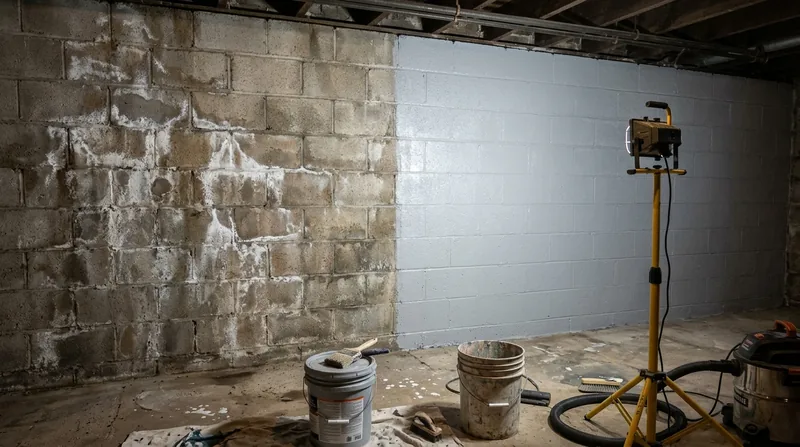




Basement Wall Sealing in Bloomington: Stopping Seepage at the Source
Bloomington sits in limestone country where the soil is thin, clay-rich, and quick to saturate during spring rains and summer thunderstorms. In older neighborhoods like Elm Heights and Prospect Hill, 1920s-1940s bungalows and foursquares often have full basements built from cut limestone or rubble stone, and those walls wick moisture and show efflorescence after every wet spell. On the east and south sides, 1950s-1960s ranches with block walls and partly finished basements seep through mortar joints and hairline cracks. Newer subdivisions on the north and southwest edges have poured full basements that develop shrinkage cracks and damp patches. Basement Wall Sealing in Bloomington addresses the wall surface itself: we clean the masonry, remove efflorescence, and apply a penetrating or membrane sealer matched to the wall type. If you want the full picture of how wall sealing fits with drainage and crack repair, start with our basement waterproofing service.
Why Wall Sealing Matters in Bloomington's Limestone and Clay
Water in Bloomington does not just move through soil; it moves through fractured Salem limestone. The same rock the county's quarries have cut for generations feeds seepage cracks, springs, and sinkholes, so a damp basement wall here is often a symptom of water traveling underground rather than a simple surface leak. Clay-rich glacial soil holds rain against the foundation, and freeze-thaw cycles open old stone and mortar joints a little wider each winter. Wall sealing helps when the problem is dampness, efflorescence, and minor surface seepage, and we tell you plainly when hydrostatic pressure means a sealer alone will not hold.
- We remove efflorescence and salt deposits so the sealer bonds to sound masonry instead of a powdery crust.
- We match penetrating sealers to porous limestone and block, and membrane sealers to poured walls with fine cracks.
- We check grading and downspout extensions, because roof water dumped at the wall defeats any sealer.
- We inspect for active weeping and hydrostatic pressure, and recommend an interior drain tile system when sealing is not the real answer.
That diagnostic step is what separates a sealer that lasts from one that peels off by the next wet spring.
Key info: A homeowner near Smithville-Sanders had white efflorescence on a block wall and assumed the wall was failing. The actual issue was a downspout discharging two feet from the foundation. Once we extended the discharge line and sealed the wall, the dampness stopped. In that case, sealing was enough.
For official guidance on permits and contractor requirements in the area, check the City of Bloomington website before work begins.
How We Seal Basement Walls in Bloomington, Step by Step
Every wall sealing job starts with a free basement inspection, because the wall material and the water source decide the method. On a 1930s cut-limestone wall in Elm Heights, we may need to repoint mortar joints before sealing. On a 1990s poured wall in a southwest subdivision, the issue is usually a shrinkage crack or damp patch that a membrane sealer can handle. We do not sell a sealer as a cure-all for hydrostatic pressure, and we say so on site.
- We inspect the wall, the floor joint, the window wells, and the grading to find where water actually enters.
- We wire-brush and wash the masonry, then remove efflorescence with a masonry-safe cleaner.
- We repair active cracks with epoxy or polyurethane injection before any sealer goes on.
- We apply the sealer in the correct number of coats for the wall's porosity and cure time.
- We check the sump basin and discharge line so water leaving the wall has somewhere to go.
If the inspection shows water pushing through the floor joint, we point you to our interior drain tile system instead of sealing over a problem that will return.
Key info: A 1950s ranch near Harrodsburg had a partly finished basement with block walls and a musty smell after every rain. The wall showed efflorescence and a few hairline cracks. We injected the cracks, sealed the block, and extended the downspouts. The dampness cleared without excavation because the water was surface-driven, not hydrostatic.
Wall Sealing Methods We Use in Bloomington
The right method depends on wall material, crack activity, and how much water pressure the wall faces. Here is how the main approaches compare for Bloomington homes.
| Approach | Description | Best for |
|---|---|---|
| Penetrating sealer | Soaks into porous masonry and blocks capillary wicking without a surface film. | Cut limestone and block walls with dampness and efflorescence. |
| Membrane sealer | Forms a flexible coating over the wall face and bridges fine hairline cracks. | Poured walls with shrinkage cracks and minor seepage. |
| Epoxy injection | Pumps structural epoxy into ports to fill and bond tight cracks. | Non-moving structural cracks in poured or block walls. |
| Polyurethane injection | Expanding foam fills wet, active leaks and flexible joints. | Active weeping cracks and floor-wall joints. |
| Parging repair | Replaces spalled or crumbling mortar before sealing. | Old stone and block walls with failing surface mortar. |
We choose the method after the inspection, not before, because sealing a wall that is under hydrostatic pressure only hides the water for a season.
Basement Wall Sealing Cost in Bloomington: What to Expect
Basement wall sealing in Bloomington starts from $1,500 for a typical single-wall job with cleaning, efflorescence removal, and sealer. Most full-perimeter sealing jobs on a 1950s block basement run higher because of wall preparation and crack injection before sealing. Old cut-limestone walls in Elm Heights and Prospect Hill can cost more when repointing is needed, and active leaks that require polyurethane injection add to the total. Access matters too: a wall crowded by storage or mechanicals takes longer to prep.
Getting two or three estimates is smart because the diagnosis matters as much as the price. A low bid that skips crack injection and seals over an active leak will not last a Bloomington spring. Ask each contractor what they found and why they chose that method. For a fuller breakdown of line items, see our pricing overview.
Hiring a Basement Wall Sealing Contractor Near Bloomington
When you search for basement wall sealing near me in Bloomington, the contractor you choose should be able to explain the difference between dampness and hydrostatic pressure without selling you a full excavation. Ask for proof of licensing and insurance, and ask for references from jobs in Bloomington or nearby towns like Ellettsville and Spencer. Permits are commonly required for structural foundation repair and work that alters drainage or the sanitary connection of a sump discharge, and thresholds vary by jurisdiction, so confirm with the local building department. Get at least two written estimates and compare the scope, not just the number.
Our contact page is the fastest way to schedule a free inspection at (812) 778-1405.
Basement Wall Sealing in Bloomington: Pricing Guide
| Service | Price | Details |
|---|---|---|
| Single wall sealing | Starting at $1,500 | Cleaning, efflorescence removal, and one coat of sealer on one wall; wall length and prep drive the price. |
| Full perimeter sealing | Starting at $2,800 | All four walls prepped and sealed; number of active cracks and wall material move the number. |
| Crack injection before sealing | Starting at $450 | Epoxy or polyurethane injection per crack; active weeping cracks cost more than tight structural ones. |
| Old stone wall repointing | On estimate | Spalled mortar and rubble stone need an on-site look before we quote sealing. |
| Travel | Included | in Bloomington and surrounding areas, no separate call-out or mileage fee |
| Estimate | Free | Response within 24h at (812) 778-1405, no obligation to book |
Indicative pricing, the exact cost depends on square footage, finish, and site access. Free personalized estimate within 24h at (812) 778-1405.


