



Bloomington sits on clay-rich soil and fractured Salem limestone, and that geology decides where water goes. Spring rains and summer thunderstorms run off the wooded hills toward low lots, and in Elm Heights, Prospect Hill and the blocks near the university, 1920s bungalows and foursquares sit on full basements of cut limestone or rubble stone. Out east and south, 1950s ranches and split-levels show seepage at the block joints. On the north and southwest edges, 1990s and 2000s subdivisions with poured full basements get water that travels through the rock itself. French Drain Installation in Bloomington intercepts that runoff before it reaches the wall, and it is often the cheapest answer to a wet basement that keeps coming back. If you are still sorting out where the water enters, start with a basement waterproofing assessment and we will tell you plainly whether a drain is the right tool.
Why French Drains Matter on Bloomington's Clay and Limestone Lots
The failure mode that dominates here is saturated glacial clay sitting on top of fractured limestone. Water perches in the clay, builds hydrostatic pressure against the footing, and finds the weakest point: a cold joint, a mortar seam in old stone, or a crack opened by the freeze-thaw cycle. Gutters that dump at the wall make it worse, and so does grading that slopes back toward the house.
- We see seepage return every spring in the older stone basements around Elm Heights and Prospect Hill, where mortar joints are the first to give.
- Ranch and split-level basements on the east and south sides collect water at the block cores and along the footing line.
- Wooded lots off the hills shed runoff downhill, and low lots in the newer north and southwest subdivisions take the brunt of it.
- Hillside properties near the county's quarry country sometimes hit a spring, and a drain is the only reliable way to redirect it.
A properly built exterior drain takes that water away from the wall instead of letting it sit against the foundation.
Key info: On a rubble-stone foundation in Prospect Hill, sealing the visible crack rarely stops the seepage. The water is coming through the wall and the footing joint, not just the crack, so we look at drainage before we quote any patching.
For the code and permit side, the City of Bloomington's building department is the authority to check with before any work that alters drainage, and rules vary by jurisdiction: City of Bloomington Planning and Transportation.
How We Install a French Drain on a Bloomington Foundation
We start by finding where the water actually comes from. That means reading the grade, the downspout layout, the soil, and the wall itself. On a wooded lot, runoff from upslope matters as much as what falls on the roof. Then we build the drain to move that water to daylight or to a sump basin, with the pipe graded so it never holds water.
- We walk the foundation and mark the high side, the low side, and every point where water is currently reaching the wall.
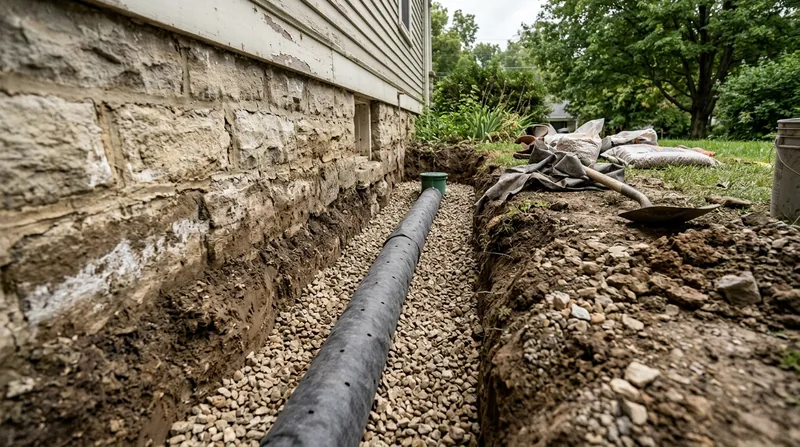
- We excavate a trench along the footing, keeping the trench bottom below the basement floor level so the drain can actually catch the water.
- We line the trench with filter fabric so clay fines cannot clog the gravel, then set a perforated pipe with the holes down and a steady fall toward the outlet.
- We backfill with washed gravel, wrap the fabric over the top, and cap it with soil graded away from the wall.
- We tie the outlet to daylight on a downhill slope, or to a sump basin with a check valve and a discharge line that empties well clear of the foundation.
- We extend downspouts and correct the grading so roof water never lands back in the trench.
Every drain we leave behind is tested with water before we backfill the last stretch.
Key info: A 1960s ranch off the south side had a downspout dumping directly into a low corner, and the block wall stayed wet for days after every storm. We ran a drain along that wall to a daylight outlet, extended the downspout, and the corner dried out. No excavation inside the basement was needed.
On tighter lots where exterior excavation is not practical, an interior perimeter drain is often the better call, and we will say so.
Drain Approaches We Use Around Bloomington
| Approach | Description | Best for |
|---|---|---|
| Exterior footing drain to daylight | Gravel and perforated pipe along the footing, fabric-wrapped, outlet on a downhill grade. | Hillside and wooded lots with a natural low exit point. |
| Exterior drain to sump basin | Same trench and pipe, but the outlet drops into a basin with a pump and check valve. | Flat lots where no daylight outlet exists. |
| Interior perimeter drain | Channel cut at the floor-wall joint, leading to a basin and pump. | Finished basements and lots too tight for exterior digging. |
| Surface and downspout correction | Regrading, downspout extensions, and swales to move roof water away. | Mild seepage where the wall itself is still sound. |
| Drain tile repair | Clearing, re-lining, or replacing failed clay or crushed pipe at the footing. | Older homes where a drain already exists but no longer flows. |
French Drain Installation Cost in Bloomington: What to Expect
Most exterior drain work in Bloomington starts around $25 per linear foot, and that figure covers excavation, fabric, gravel, pipe, and backfill. The number moves with trench depth, how much hand digging is needed next to a stone foundation, the outlet (daylight is cheaper than a new sump basin and pump), and access. A drain on a tight lot in Elm Heights with mature trees and a fence in the way costs more per foot than an open run on a newer lot off the north side.
Get two or three estimates and ask each one what the outlet is and where the water ends up. A quote that does not answer that question is not a complete quote. Our full breakdown lives on the pricing page, and a free inspection confirms the length and route before any number is final.
Hiring a Waterproofing Contractor Near Bloomington: What to Check
Ask for the license and insurance certificate before work starts, and confirm the policy covers excavation and damage to existing walls. Get at least two written estimates with the drain route and outlet described, and ask for references from jobs in Bloomington or Ellettsville you can call. If the property is in a historic district or has protected trees, check with the city before digging, and check any HOA rules on drainage discharge. A contractor who hesitates on those questions is telling you something.
Call Bloomington Waterproofing at (812) 778-1405 to schedule a look at your lot.
French Drain Installation Near Me: What Bloomington Homeowners Should Know
When you search for French drain installation near me, the results do not tell you whether the company understands limestone country. Ask whether they have worked on rubble-stone and cut-limestone foundations, and whether they will test the drain with water before backfilling. We serve Bloomington and the surrounding towns, including Ellettsville and Spencer, and we will tell you when a simple grading fix is enough.
French Drain Installation in Bloomington: Pricing Guide
| Service | Price | Details |
|---|---|---|
| Exterior drain to daylight | From $25/linear ft | Includes excavation, filter fabric, gravel, perforated pipe, and backfill with a downhill outlet |
| Exterior drain to sump basin | From $32/linear ft | Adds a basin, pump, check valve, and discharge line where no daylight outlet exists |
| Interior perimeter drain | From $40/linear ft | Cut at the floor-wall joint with basin and pump, used on finished basements and tight lots |
| Drain tile repair | On estimate | Scope depends on how much old clay or crushed pipe must be dug out and replaced |
| Estimate | Free | On-site inspection with drain route and outlet confirmed before any number is quoted |
Indicative pricing, the exact cost depends on square footage, finish, and site access. Free personalized estimate within 24h at (812) 778-1405.


