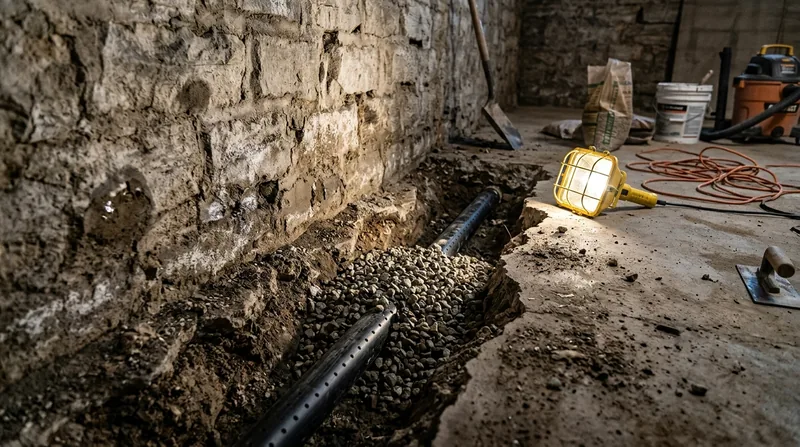




Interior Drain Tile System in Bloomington: Cut Limestone, Clay Soil, and Water That Rises
Bloomington sits on clay-rich soil no more than a few feet deep over fractured Salem limestone, and that geology decides how water behaves under your basement. Spring rains and summer thunderstorms soak the wooded hills, water moves through the rock as well as the soil, and it shows up under the slab of Elm Heights bungalows, Prospect Hill foursquares, and the 1950s ranchers out toward Smithville-Sanders. An Interior Drain Tile System in Bloomington intercepts that water at the footing before it reaches your floor. We cut the perimeter, lay perforated pipe in washed stone, and route everything to a sump basin with a pump that moves it outside. If you are still comparing approaches, start with our basement waterproofing overview, then read how the interior perimeter drain works below grade.
Why Bloomington Basements Take On Water From Below
The dominant failure here is hydrostatic pressure, not a single bad crack. Clay holds rainfall against the foundation, the limestone beneath it carries water laterally, and the water table lifts after a wet week. Old cut-limestone and rubble-stone walls in Elm Heights and near the university were never built with a footing drain, so water finds the weakest joint. Poured walls in the 1990s subdivisions on the north and southwest edges crack at the cove and seep at the tie holes.
- Water rises through the slab-to-wall joint after heavy rain, which points to pressure under the floor rather than a wall crack.
- White efflorescence and a musty smell return every spring because moisture keeps moving through the masonry.
- An existing footing drain clogs with clay fines and stops carrying water, so the basement floods at the same spot each storm.
- Freeze-thaw cycles open old stone joints wider each winter and give water a straighter path inside.
When those signs line up, sealing the inside face of the wall alone will not hold, and an interior perimeter drain is the honest fix.
Key info: A homeowner near Harrodsburg had water crossing the floor every March and patched the same crack three times. The crack was not the source. Water was rising at the footing, and the interior drain tile captured it before it reached the slab.
Indiana's building rules for drainage and sump discharge are set locally, so verify requirements with the City of Bloomington's planning and building department before work begins: bloomington.in.gov.
How We Install an Interior Drain Tile System in Bloomington
We work from the inside, so the job does not depend on the season or on digging up a mature yard. The sequence is the same whether the basement is a cut-limestone full cellar or a poured 1990s foundation, but the wall detail changes. We break out a strip of slab at the perimeter, dig down to the footing, and set the pipe so it can collect water from both the wall and the floor.
- We inspect the basement, map where water enters, and check the wall type and footing depth before quoting.
- We saw-cut and remove a 12 to 16 inch strip of slab along the perimeter and excavate to the footing.
- We lay perforated drain tile in washed stone, wrap it in filter fabric, and pitch it toward the sump basin.
- We set the sump basin, connect the discharge line with a check valve, and run it to a freeze-safe outlet.
- We backfill with stone and concrete, then seal the wall joint and parge where the old masonry needs it.
On stone foundations we also address the wall itself, because an interior drain handles the water but does not stabilize a bowing wall. Our bowing wall repair page covers when carbon fiber straps or wall anchors are the right call.
Key info: In a 1958 split-level off the east side, the footing sat higher than the slab and the original drain had silted solid. We tied the new interior perimeter drain to a deeper sump basin and added a battery backup, so the pump keeps running through the storms that knock out power.
Interior Drain Tile Compared With Other Approaches
Not every wet basement needs the same answer, and we tell homeowners plainly when a cheaper repair will do. Epoxy or polyurethane injection stops an active crack in a poured wall, but it does nothing for water rising under the slab. Exterior excavation works, yet it means digging out established plantings, walks, and porches. The table below shows where each method fits.
| Approach | Description | Best for |
|---|---|---|
| Interior perimeter drain tile | Pipe at the footing inside the basement, draining to a sump basin and pump. | Water rising at the slab joint and hydrostatic pressure under the floor. |
| Crack injection | Epoxy or polyurethane forced into a poured-wall crack through injection ports. | One active, non-structural crack with no water under the slab. |
| Exterior waterproofing | Membrane and footing drain installed from the outside after excavation. | Major wall seepage where the yard can be opened and restored. |
| Drain tile repair | Clearing or replacing a clogged original footing drain and its sump connection. | An existing tile line that has silted shut but is otherwise sound. |
We recommend the interior system when the water is coming from below and the basement needs to stay usable year after year.
Interior Drain Tile System Cost in Bloomington: What to Expect
Most interior systems here start around From $50 per linear foot, measured along the perimeter we open. A simple 30-foot run on a poured wall in a newer southwest subdivision sits near that starting point. A full cut-limestone perimeter in Prospect Hill costs more because the stone needs careful handling, deeper excavation, and sometimes parging and wall sealing. Sump basin, pump, and discharge line are quoted as part of the job, not hidden extras.
- Wall material matters most: rubble stone and early block take longer than poured concrete.
- Access counts: a finished basement means moving stored goods and protecting flooring before we cut.
- Total perimeter length drives the number, so a small bungalow costs less than a full foursquare.
- Pump capacity and a battery backup add to the figure but change how the system performs in a storm.
Get two or three written estimates and compare scope line by line, not just the bottom number. Our full pricing overview shows how the components break down.
Choosing a Waterproofing Contractor Near Bloomington: What to Check
Interior drain work is invasive, so the contractor matters as much as the method. Ask for proof of licensing and insurance before anyone cuts your slab, and confirm the certificate covers general liability. Get the scope in writing: pipe type, stone, basin size, pump model, and what happens to the old concrete. Ask for references from jobs in Bloomington or Ellettsville and call them.
- Confirm the permit picture with the City of Bloomington before work starts, since drainage and sump discharge rules vary by jurisdiction.
- Ask whether the estimate includes patching the slab and sealing the wall joint, or whether those are add-ons.
- Check that the discharge line runs to a legal outlet and does not dump water onto a neighbor's lot.
- Get the warranty terms in writing and confirm whether it transfers if you sell the house.
Bring your questions to a free estimate, and we will tell you if a simpler repair is enough.
Interior Drain Tile System Near Me: Timing and Season in Bloomington
Because we work inside, an interior drain tile system can be installed in any season, and that matters in a climate with real freeze-thaw cycles. Demand peaks in March and April when the water table lifts after spring rains, and again in July when thunderstorms drop inches in an hour on the clay hills. Late fall and winter are quieter, which means faster scheduling and less disruption to a finished basement. If your sump pump fails during a storm, call (812) 778-1405 and we will get a crew out to assess the system. For the full range of drainage work on your property, see our drain tile repair page.
Interior Drain Tile System in Bloomington: Pricing Guide
| Service | Price | Details |
|---|---|---|
| Interior perimeter drain tile, poured wall | Starting at $50/linear ft | Includes saw-cut, excavation, perforated pipe in washed stone, and concrete patch along the run. |
| Interior perimeter drain tile, cut limestone or rubble stone | Starting at $65/linear ft | Adds careful stone handling, deeper footing excavation, and joint sealing on old masonry walls. |
| Sump basin, pump, and discharge line | Starting at $850 | Includes basin, primary pump, check valve, and discharge routed to a legal freeze-safe outlet. |
| Battery backup sump pump | Starting at $450 | Keeps the system running through storm-related power outages, installed with the primary pump. |
| Complex or large-scale job | On estimate | Finished basements, long perimeters, and structural wall issues need an on-site look before a number is given. |
| Estimate | Free | Response within 24h at (812) 778-1405, no obligation to book. |
Indicative pricing, the exact cost depends on square footage, finish, and site access. Free personalized estimate within 24h at (812) 778-1405.


